


 17 / 74

February 17 - March 16, 2018
|
17
‘mood’ fog and ‘functional’ fog.” With prompt technical tweaks, the
principals could see each other, and be seen by the audience.
Performers, the creative team, and Lyric staff may have a general
sense of what a production’s sets and costumes look like, “but sometimes
you don’t know what the
effect
is until the PRT,” says Elise Sandell, a
frequent assistant director for Lyric productions. The chorus members
“always get so excited, seeing each other in costumes for the first time.
They take a lot of selfies. It adds a level of fun to PRTs. It’s a challenge
-
either you wear the costume or the costume wears you! The chorus
members have to assimilate the costumes in a very short time; they’re in
full costume only for the PRT and for the final dress rehearsal” before the
performances commence. For the stage-orchestra rehearsals in between,
the soloists wear costumes, while the chorus members are in street clothes.
The assistant director sits with the production director and designers
at the tech table in the middle of the main-floor seating area during
the PRT, shuttling back and forth to the stage as needed. Sandell gets
through PRTs with “LaraBars and trail mix, and you have to hydrate. The
most important thing for keeping calm is lots of deep breaths. It’s easy
for everyone’s fuses to get short. I’ve learned from working at Lyric that
how I see a challenge, how I meet it, and how I choose to talk about it
can either make everyone’s day better or worse. I try to keep my attitude
optimistic and realistic. You have to crawl before you can walk, and
walk before you can run. A PRT is crawling, with a little standing and
walking, so that you can run by dress rehearsal.”
PRTs for revivals of productions previously staged at Lyric and
elsewhere are generally easier than for new productions, Sandell observes.
“Someone’s worn that costume before, and there are notes. With all the
hoop skirts in
Eugene Onegin
, Act Two, director Paula Suozzi could tell
people which ring of the skirt to pick up. With a revival you know where
the problems are and solve them before they crop up.” New productions
can match first-time parenthood for anxious anticipation, but the payoff
is worth it: Sir David McVicar’s production of
Elektra
, once everything
came together, “was jaw-dropping and so much fun,” Sandell recalls.
During a PRT “you have to manage everybody’s time,” she
continues. “I make a schedule with the stage manager, who is the king
when the show is onstage
-
it’s as much the stage manager’s rehearsal
during the PRT as the director’s.” Each production presents its own
special challenges. “For
My Fair Lady
there were 350 costumes on about
80 people
-
so many costume changes, eight different scenes in the
show, all the moving scenery which has to be lit in different positions
with different timings and different effects
-
with dancing added in,”
Sandell recounts. “For the world premiere of
Bel Canto
, almost everybody
was onstage the whole time, which made it logistically impossible to tech.
A PRT is the day everybody works the hardest, the full gamut of every
department that touches the onstage product
-
dressers, props crew,
stage managers, singers, music staff.”
Eric Weimer of Lyric’s music staff notes that a PRT is the first time to
hear the offstage musicians that many operatic scores require. “Do they need
to sound like they’re in the next room or the next county?” he quips. Those
musicians’ audibility is affected by set design and location. “Those of us who
are pianists have a romantic notion of the PRT
-
it’s our chance to play,
and as close as we get to public performance. In our minds it’s a big thing!”
On the other hand, Weimer realizes, for nearly everyone else the PRT “is
not about the music. A lot of the singers aren’t singing out. They’re more
concerned with ‘What do I do with my train?’ ‘My gown doesn’t fit!’ ‘What
do I do with my sword?’
-
the details of the production.”
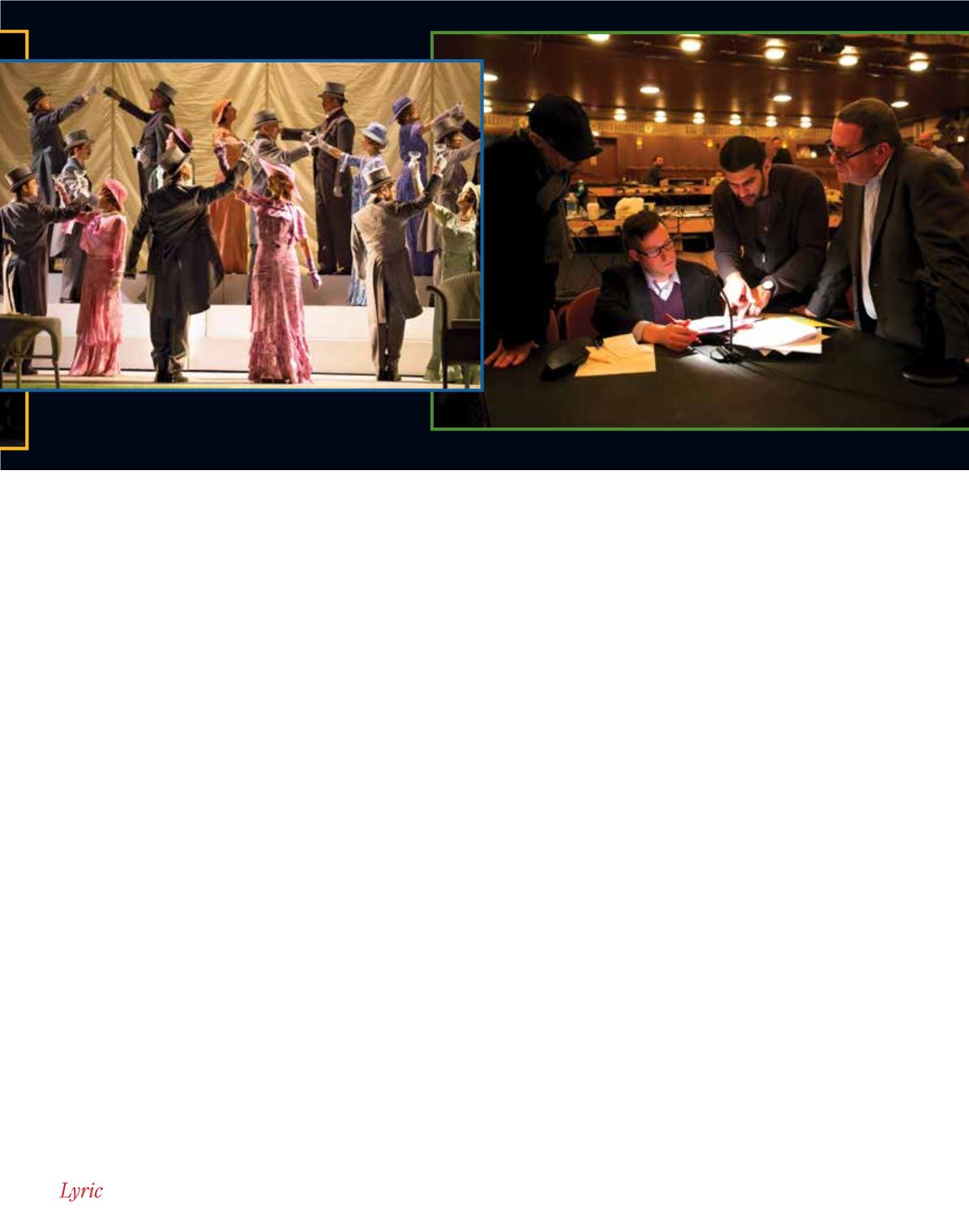
leap safely onto the table to claim his promised sword and sister-bride Sieglinde (Elisabet Strid) while the scenery shifted around them; (above)
My Fair Lady
cast
members had a scant nine minutes to change from racetrack to ballroom attire; (right) at one of the two PRTs for the world premiere of
Bel Canto
, Derek Matson
(seated), who adapted Nilo Cruz's libretto for surtitles, discusses the script with (left to right) Cruz, composer Jimmy López, and Lyric general director Anthony Freud.
TODD ROSENBERG
TODD ROSENBERG