


 18 / 74

18
|
February 17 - March 16, 2018
Longtime Lyric dresser John Salyers remembers that in
Das
Rheingold
, Wotan and Alberich’s shocking fight for the ring went back
to the drawing board after the PRT. “The director and designer wanted
lots of blood when Alberich’s arm was ripped off, so we had to figure out
how to accomplish that in a simple way and also make sure that the arm
would come off easily, yet not fall off unintentionally before the effect
was to happen. After a huge effort to get it to work, it was decided with
the color of the stage floor the audience wouldn’t see the blood, so that
aspect was removed and we then focused on just making sure the arm
would come off when it was supposed to.”
Rachel Henneberry, both a stage manager and assistant stage
manager (ASM) at Lyric, remembers that for
My Fair Lady
she was stage-
right ASM “in charge of wardrobe paperwork
-
entrances, exits, how
much time for each change, working out where and how to do changes
[with wardrobe director Maureen Reilly] for everyone in the show
-
principals, supernumeraries, chorus, dancers. The most complicated
change was going from Ascot to Ball, where literally everyone but
Donald Maxwell [as Alfred Doolittle] and Bryce Pinkham [as Freddy
Eynsford-Hill] had to change. The majority had nine minutes for a
complete change, including tiaras and other accessories. Some had less
than four minutes. You have an army of crew who literally help cast
members dress as quickly as they can, to motivate wig changes, adding
tiaras, and keeping people on focus so they can get right back onstage.
“In doing that change for the first time during the PRT, you realize
you can do certain things to make the change go faster, like having ten
women go to have their tiaras put on first, then add their dresses
-
that’s
being more efficient. The dressers aren’t bombarded by 21 women at once
-
they get 10 and the wig-makeup crew get 11, and then they swap.”
Richard E. Grant’s PJs also needed work, Henneberry recalls. As
Henry Higgins, “he changed from pajamas to a linen suit just offstage of
the doorway in Act Two. I was behind the wall with him, his dresser John
Salyers, and props assistant Mike Berger with shoehorn and toothbrush.
My job was to make sure they all did the right things at the right time,
and that they gave Mr. Grant his cue lines in a stage whisper, a helpful
reminder while he was dressing. During the PRT he was fumbling with
the buttons on his pajamas,” so they were switched to Velcro. “It looked
buttoned, but we could rip it apart offstage.”
For
Eugene Onegin
, Henneberry oversaw props paperwork. “That
was a very props-heavy show, with lots of chairs, apples being peeled,
bread, tables, leaves laid out by the props staff for the opening scene.”
Because it was a revival, there were existing photos and notes about the
pre-sets and special handoffs, “like a tea-tray an artist needed to have
put in hand by a props person. Much invisible teamwork goes on. You
fine-tune during the PRT; you’re onstage under show conditions for the
first time -- you’ve got to work it out on the spot.” PRTs can be “like
wrangling a preschool class. You know who’s walking in the door but you
don’t know what’s going to happen. Then you punt, figure it out, and fly.”
Magda Krance is Lyric’s director of media relations. Prior to joining the
company in 1992, she was a fulltime freelance journalist for
The New York
Times, Time, People, Chicago Tribune
, and other publications.
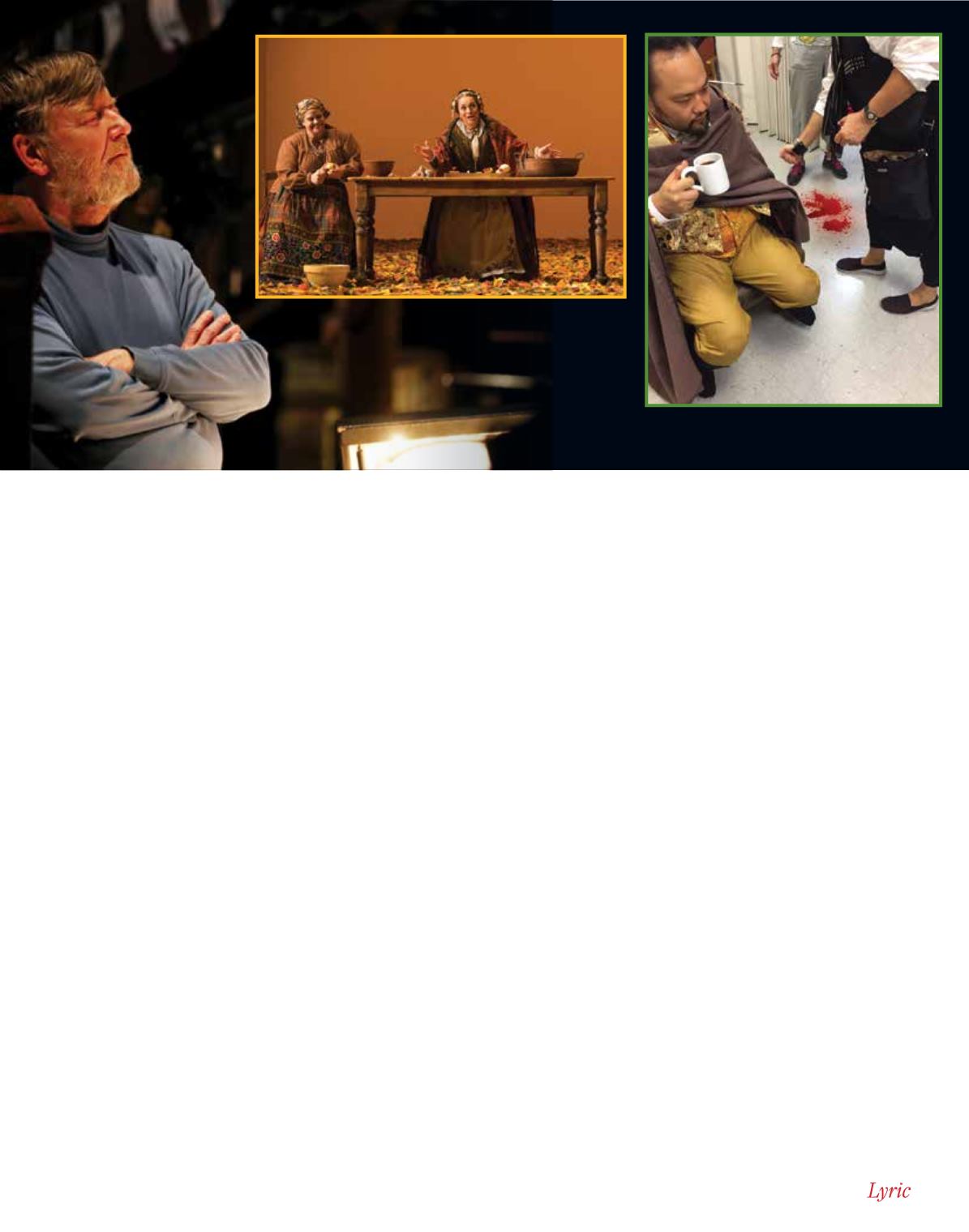
(Left) Sir Andrew Davis during the PRT for
Les Troyens
; (center) although the staging seemed airy and minimalistic,
Eugene Onegin
had an extensive
and complicated props list, encompassing a rustic table, bowls, potatoes, apples, knives, piles of books, an oil lamp, pitcher, and writing table; and dozens
chairs; (right) blood test: during
Das Rheingold’
s PRT, Samuel Youn endures costume adjustments before Alberich’s big fight to keep the ring.
JOHN SALYERS
TODD ROSENBERG