



 31 / 72

focus on who I am for that performance. I want things to be as normal as
possible. I only want my family around. Because it’s such a long day before
Elektra
starts. Once, the day of an
Elektra
performance in New York, I
wanted to hide a bit, and so I went to an exhibition, but I was recognized.
And for
Elektra
, I really want to stay in my bubble before I go onstage that
night.”
It’s not an easy role to shake. Stemme says that “all the emotions of
the opera, particularly the emotional climaxes, stay with me for a long time
after each performance. e character of Elektra may be gone, but not the
emotions of hers that I have sung. I try to just keep on and not do too
much about it – otherwise, I don’t think my own family would be very
happy! ere are times when I have to tell myself, ‘Stop acting like Elektra!
And don’t go for that axe!’”
For Lyric’s debuting conductor, Donald Runnicles, a night spent
with
Elektra
is, if anything, invigorating. “I don’t ever feel exhaustion after
conducting
Elektra
,” he says. “I feel elation. Certainly it’s a complex work
to conduct and to keep together. But it doesn’t lead to exhaustion. If it
did, that would mean there was something I hadn’t done right. Certainly,
there is some emotional exhaustion, due to the roller-coaster you’ve just
been on for 100 minutes. But it’s really not until a couple of hours later,
or even the next morning, that I realize – ‘Hmmm…I conducted
Elektra
last night.’ It’s the same way with the
Ring
. At the end of any of the
Ring
operas, yes, I’m emotionally quite tired. But I could probably physically
conduct another act!”
Runnicles and Stemme are close friends and colleagues, and they
have done numerous performances of
Elektra
in Berlin together. Because
of Strauss’s heavy orchestration, it’s essential for a conductor – and his
orchestra – to be alert to the demands this opera makes on singers. “I think
it’s primarily a matter of sensitizing the orchestra to the fact that there are
people singing,” explains Runnicles. “You want them to be able to listen
to the singers, to hear them from the pit. If it’s played really meticulously,
and if the orchestra takes the dynamics seriously, there are very few places
where you’ll have to reduce the dynamics. But that’s a conductor’s job – to
make it very clear to the players that what they have in front of them is
what they should be playing, and that they should not gravitate to the
strongest dynamic. If the dynamics are played exactly as printed, there
should be no huge balance problems with the sound between the pit and
the stage. Of course, every opera house has a different acoustic, and this
will be my first time at Lyric – so I plan to get out of the pit at some point
during rehearsals and into the house to see how the balance is being
maintained. e work is phenomenally orchestrated and phenomenally
composed, and that’s what rehearsals are for – context, context, context.”
A role like Elektra demands such vocal weight and interpretive
authority that a dramatic soprano must grow into it. It cannot be taken on
in the early stages of a career. “I had heard that Elektra was so dramatic,”
says Stemme, “and so difficult, that I waited as long as I could to sing it.
Somehow my schedule took care of that by itself, once I had said yes to
Isolde and Brünnhilde. And I tried to sing the Italian repertoire as long as
possible. You know, Verdi doesn’t make it as easy to know the layers and
emotions of his characters as a playwright like Hoffmannsthal does. It’s all
there in the text. And Strauss responds to this text in the most fantastic
way. Now I’m starting the Dyer’s Wife [in
Die Frau ohne Schatten
].
I don’t know if she’s exploding or
im
ploding her emotions, but she can’t
express them. Elektra is perfectly able to express them, but the Dyer’s Wife
needs an entire opera to learn how to express herself!”
It’s said that Strauss’s own advice to
Elektra
conductors was that it
should be conducted like “fairy-tale music.” Realistically, that can only be
applied to one or two sections of the score, but it gives us an idea of how
a conductor can harness his enormous orchestra and allow the voices to
come through. “I think what he was getting at,” says Runnicles, “is that
there are moments of heavy articulation, but there are also moments that
should be played lightly. I think he’s also implying that the orchestra
players need to be aware of their specific role in the melodic line, and the
need to keep it in a Mendelssohnian vein. In movie footage of Strauss
conducting his music – and he was a master conductor – you can see that
O P E R A N O T E S | L Y R I C O P E R A O F C H I C A G O
February 2 - 22, 2019
|
31
WIENER STAATSOPER/MICHAEL POEHN
BETTINA STOESS
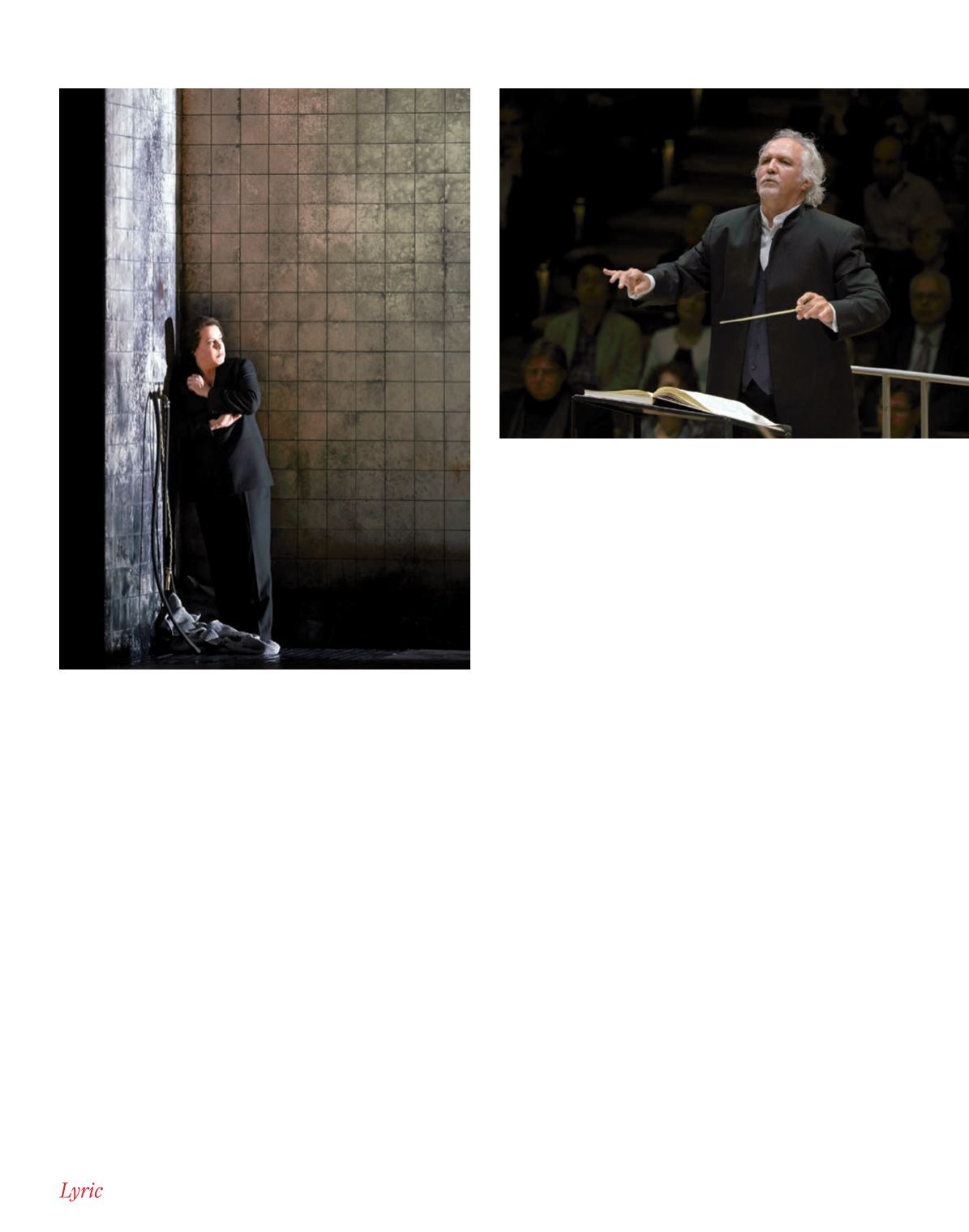
Nina Stemme in
Elektra
at the Vienna State Opera.
Donald Runnicles in rehearsal at the Deutsche Oper Berlin.