


 34 / 72

L Y R I C O P E R A O F C H I C A G O
34
|
February 2 - 22, 2019
Shortly before Lyric’s production of
Elektra
premiered in 2012, its original director,
Sir David McVicar, responded to Sir David
McVicar responded to questions from the
company’s director of media relations,
Magda Krance. (Edited by the company’s
dramaturg, Roger Pines.)
What makes
Elektra a
great opera?
e score – it’s a combination of libretto and music
that is simply a marriage made in heaven. is
was Hugo von Hofmannsthal’s first collaboration
with Richard Strauss, a turning point in both
their lives. It was Hofmannsthal who made the
relationship happen, having recognized something
in the
Salome
score – Strauss’s music is, after all,
so reflective of the time in which he lived. In
Salome
he was exploring his characters’ inner
psychology, and Hofmannsthal knew Strauss could
do the same with
Elektra
. is piece is really a
wonderful meeting of minds, and on every level, it
absolutely works.
Elektra
has been compared to a
hunk of black granite: where
Salome
is shimmering
and exotic,
Elektra
is brutal and uncompromising.
e era in which it was written is rather
signi cant, isn’t it?
Yes, 1909 – think of Russia, with revolution
happening initially in 1905-06, then 1911-14, then
1917-24. ere’s a strong political element here
that’s very interesting, in that we’re dealing with a
closed society that needs to change – the old order
is massacred. You can compare Elektra to a
freedom-fighter! In Strauss’s closing bars you have
one of the most chilling things in the opera: as
Elektra dies, Chrysothemis turns and calls for
Orest’s help, but the doors are barred shut. ere is
no explanation for that in Hofmannsthal’s text,
but it’s very telling. And think about it – a regime
change hardly ever solves anyone’s problems.
is is a 20th-century political sensibility that
Hofmannsthal brings to Greek myth, still very
resonant for us now.
Is
Elektra
a piece that you wanted to stage for
some time?
For a long, long, long time. I finally did
Salome
at
Covent Garden five years ago, and that was also
the fulfillment of a long-held ambition. Once I got
it under my belt, I knew
Elektra
was the next one.
It’s just so damned visceral. Even if we ignore
the psychology and mythology, it’s totally gripping
drama – I don’t think there’s anything in opera to
compare with it. It’s kind of like an opera written
by Quentin Tarantino in the way it notches up the
tension. You know the explosion of violence has to
come, and it’s incredibly shocking and cathartic
when it does.
Elektra
is the third Strauss opera you’ve directed.
Chronologically speaking, you’ve zigzagged from
the later with
Der Rosenkavalier
to the earlier,
Salome
, before arriving at
Elektra
.
Yes, working through Strauss’s musical language,
experiencing him in a non-linear way – it’s certainly
an interesting way of looking at Strauss’s music,
from the most popular to the most controversial
of his scores. When it premiered,
Elektra
was
really shock-horror-shock-horror. is was the
most arduous score ever written. Even Ernestine
Schumann-Heink, who created the role of
Klytämnestra, said it was insanity – screaming like
the Furies, absolute chaos and anarchy. ere
were strikes by the orchestra, with people saying it
wasn’t singable or playable or listenable. No
one had ever heard such large orchestration, and
the psychological density of it was difficult for
the Austro-Hungarian-German public. Everything
about the piece was disturbing.
And it’s still as di cult to perform as it was in
that rst performance.
But it’s such a well-written score! If the cast is
true to the drama, they’ll find a way to sing it.
Of course, it’s an opera for herculean, Olympically
athletic singers. ey have to be dramatic rather
than careful. At the same time, they must have the
stamina to get from A to Z – that’s a prerequisite.
And they have to throw themselves into the drama,
especially the three principal women. In singing
and acting any role in the piece, you have to
inhabit it 100 percent and simply lose yourself in it.
It’s a short, intense opera – shorter than a lot of
lms. Consider the Klytämnestra-Elektra scene:
that’s a pretty complicated relationship. How do
you esh it out in barely 20 minutes?
I don’t have to, it’s all been done for me in the
score. If it were any longer, it would be too long.
Salome
and
Elektra
are both short, yet not a bar
too long – perfect pieces, both of them.
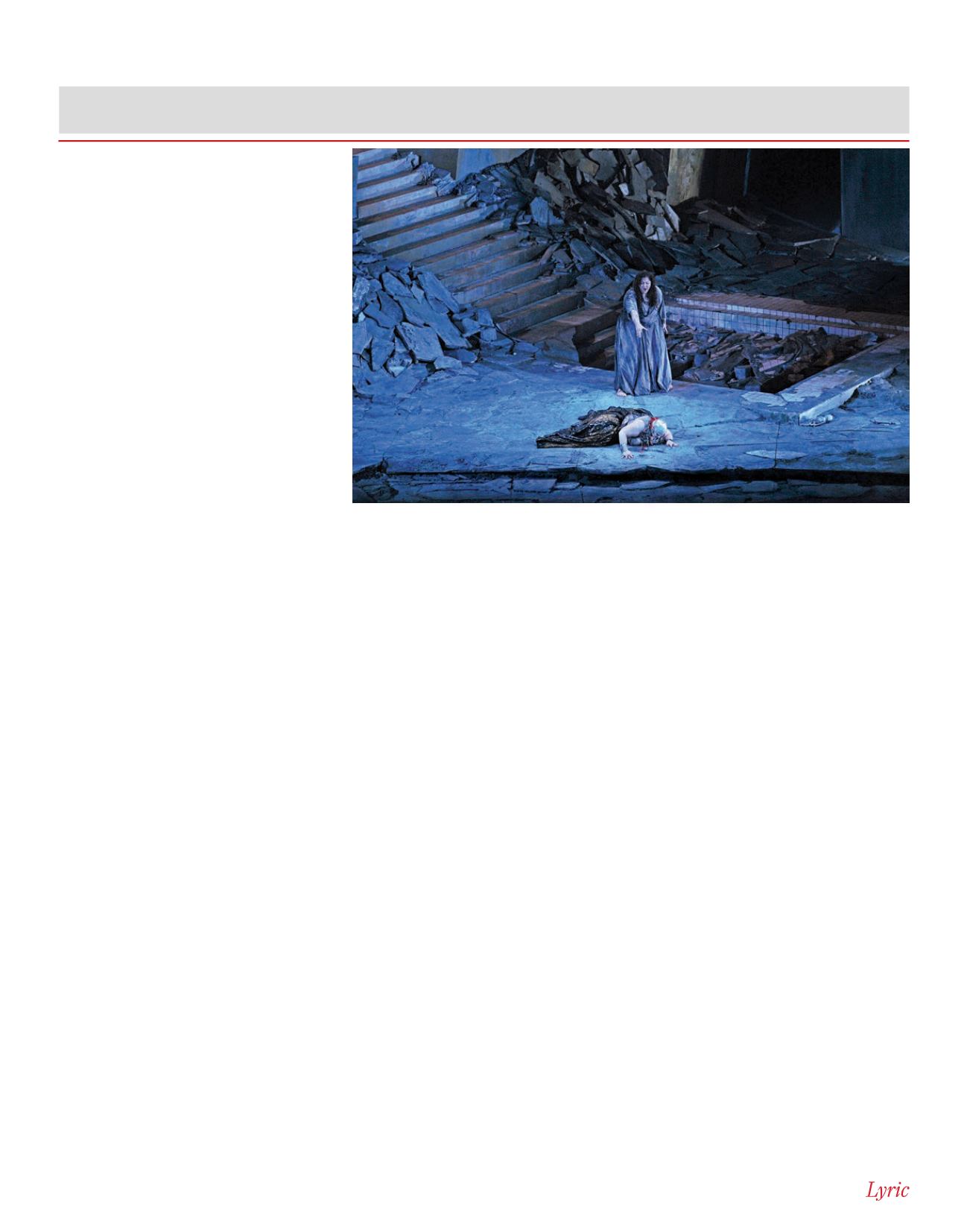
Our designer, John Macfarlane, was inspired by
North African tribal traditions, and the set
design is inspired by the bombed-out institutional
buildings from the Bosnian-Croatian con ict.
We’ve actually made a decision to root the piece
in an environment that’s mythological. I wanted to
buck the trend of being too specific regarding
placement of the story in our time, and to root it in
an environment that is freer, avoiding the reductive
clichés. We are dealing with resonant images of
war, but also with mythology.
In speaking about
Elektra
, Anthony Freud has
described it as an excellent introduction to opera
for rst-timers, especially those who appreciate
powerful theater and lm experiences.
I would agree, especially teenagers – it will blow
their minds! ink of the anger expressed in this
piece. It’s about rage, matricide, disempowerment
between generations. It’s also about revolution and
not accepting the status quo. e music will also
grab young people – the sheer loudness of it.
(You think a rock concert is loud?) is score
screams from a very primal part of the psyche.
In the end, that’s what is fundamentally gripping
about the music and the story – they speak about
primal impulses and family relationships that
are not always healthy. Its Freudian connection
speaks about rites of passage, psychological needs
for children to supplant their parents. Very, very
few people in the audience will find nothing to
relate to in experiencing this opera.
Director’s Note
Christine Goerke (standing) in the title role and Jill Grove as Klytämnestra in
Sir David McVicar’s production of
Elektra
at Lyric (2012/13).
ROBERT KUSEL