



 30 / 72

O P E R A N O T E S | L Y R I C O P E R A O F C H I C A G O
30
|
February 2 - 22, 2019
I
n its tight hour and forty minutes – the length of the average feature film – Richard Strauss and
Hugo von Hofmannsthal’s
Elektra
manages to pack in enough terror, tension, and unexpected
beauty to leave an audience weak at the knees. It was the sheer genius and creative synergy of
Strauss and Hofmannstahl in this, their first collaboration, that spawned a work whose savage
brilliance remains unique in the operatic canon.
It almost didn’t happen. Following the success of
Salome
, with its libretto based on Oscar Wilde's
scandalous play, Strauss was drifting toward other tales out of history and the Bible. Hofmannsthal
had been pursuing a collaboration with the elusive Strauss for years, during which time he successfully
steered him away from taking on the Borgias, Semiramis, Saul and David, and even a comedy. ( at
would come later, with
Der Rosenkavalier
.) Finally, in 1905, Strauss saw Hofmannsthal’s stage
version of Sophocles’s
Elektra
in Berlin, and knew that it should be his next opera. Hofmannsthal
had, of course, made the ancient Greek drama newly relevant to a German-speaking world that was
now embracing the revolutionary psychological theories of Sigmund Freud. Opera was ready to grow
beyond the more broadly drawn protagonists of the nineteenth century and face the challenge of
infusing itself with a new level of sexual and psychological insight.
Salome
had already been a
harbinger of this trend, which would soon be taken up by other German and Austrian composers
such as Franz Schreker, Erich Wolfgang Korngold, and Alexander von Zemlinsky.
To Hofmannsthal’s visceral emotional poetry, Strauss brought a score that hit with the force of
a sledgehammer. Audiences were stunned, and they remain so over a hundred years later. is
uncompromising, cathartic work still has detractors among operagoers who would rather hear
L’elisir
d’amore
or
La bohème
. Strauss pushed musical violence and brutality to its limits in
Elektra
, so much
so that he never again composed another work so steeped in horror. Only in certain passages of
Die Frau ohne Schatten
would he again make use of such
a nightmarish tonal palette. It was as if he had completely wrung out that aspect of himself – and then moved on. As director Rudolf Hartmann put it in
Richard Strauss
:
e Staging of His Operas and Ballets
, “
Salome
and
Elektra
– no matter how contrasted they may be – constitute an impressive foundation
to Strauss’s dramatic work; they represent a chapter complete in itself, with no sequel.”
But what does
Elektra
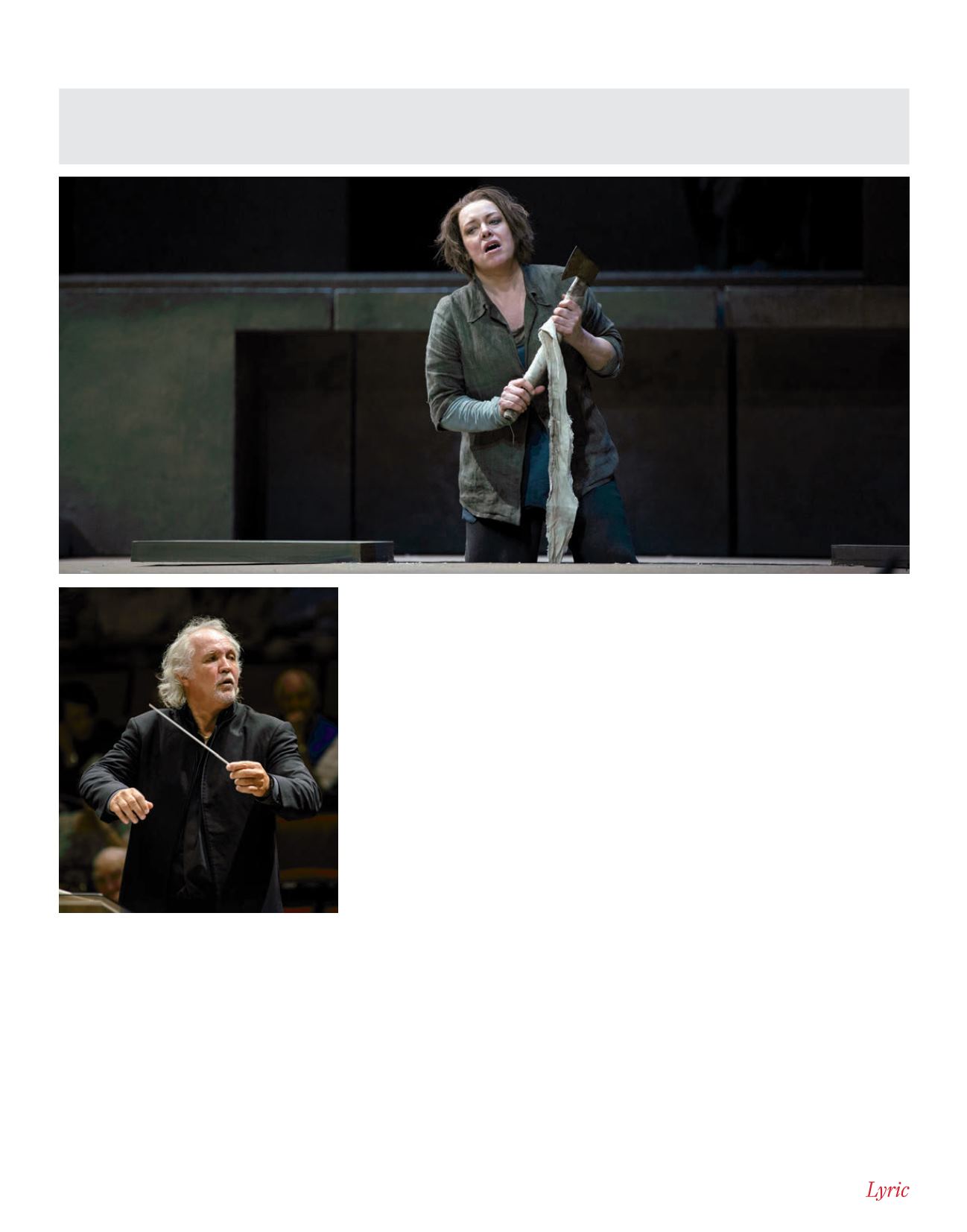
require from those who actually perform it – and what does it take out of them? Nina Stemme, this season’s Elektra at Lyric,
has sailed through the score and its huge orchestration numerous times with her full-scaled dramatic soprano voice. Yet a performance of
Elektra
always
leaves its mark. “It’s all about how you
learn
the part,” she says. “You have to be very careful to savor the softer moments, and pace your voice so that it’s
still in the best of shape for the key scene which, for me, is the Recognition Scene with Orest. It’s the most emotional one, but the scene with Klytämnestra
is the most dramatically challenging one. So if you scream your vocal cords out of your throat, you are in deep trouble. Also, when you are singing Elektra,
you are, at every moment, in the here and now. I remember the first time I sang it, and I was thinking, ‘Oh! I can’t believe she has this other big scene
coming up!’”
Solitude is Stemme’s way of preparing herself for this taxing role. “On the day of the performance, I do tend to go into my own mental corridor, to
How ey Handle
Elektra
By Eric Myers
MARTY SOHL/METROPOLITAN OPERA
GRAND TETON MUSIC FESTIVAL
Nina Stemme in
Elektra
at the Metropolitan Opera.
Donald Runnicles