


 32 / 72

O P E R A N O T E S | L Y R I C O P E R A O F C H I C A G O
he uses very minimal gestures. e smaller the gesture, the more lightly the orchestra will play. e horse
doesn’t need to be flogged all the time.”
Following
Elektra
’s premiere, Strauss made a few pages of cuts in the score, totaling under a minute
of music, to the scenes with Klytämnestra and with Orest. ese cuts have now become standard practice,
and will be observed in Lyric’s performances. “ ey were made largely to accommodate the stamina of the
singers,” says Runnicles, “and I think the singers are grateful for them. Frankly, it’s not the best music in
the score. Strauss realized that less was more. And I don’t think the cuts distort the structure, or interfere
with the drama or the tension. We’re already impatient to get to the dénouement; the feeling is that you
want to keep things moving, and the audience is eager to get to the climax. When this opera is done well,
it just races by.”
Although
Elektra
flows smoothly, its structure is divided into four distinct major scenes, each with its
own climax, and each building upon the previous one until the opera reaches its gruesomely celebratory
conclusion. One of the many concerns for an
Elektra
conductor is to maintain the opera’s framework as an
organic whole.
Runnicles does not see that as a problem. “In any given moment while I’m conducting,” he says, “I’m
not thinking about structure, or about what’s going to happen a half an hour later. e score itself is so
brilliantly paced that the biggest challenge is just doing what’s there. Just trying to realize what Strauss
wants. If you can achieve what Strauss has written, then that’s really something. Don’t mess with it! If
anybody is wondering what Runnicles’s
Elektra
is going to be like – well, I’ll be perfectly happy if what they
hear is Strauss’s
Elektra
.”
Eric Myers has written for
Opera News, Opera
(U.K.),
Time Out New York, Variety
, and
e New York
Times
. He is also the author of
Uncle Mame: e Life of Patrick Dennis
(St. Martin’s Press, 2000).
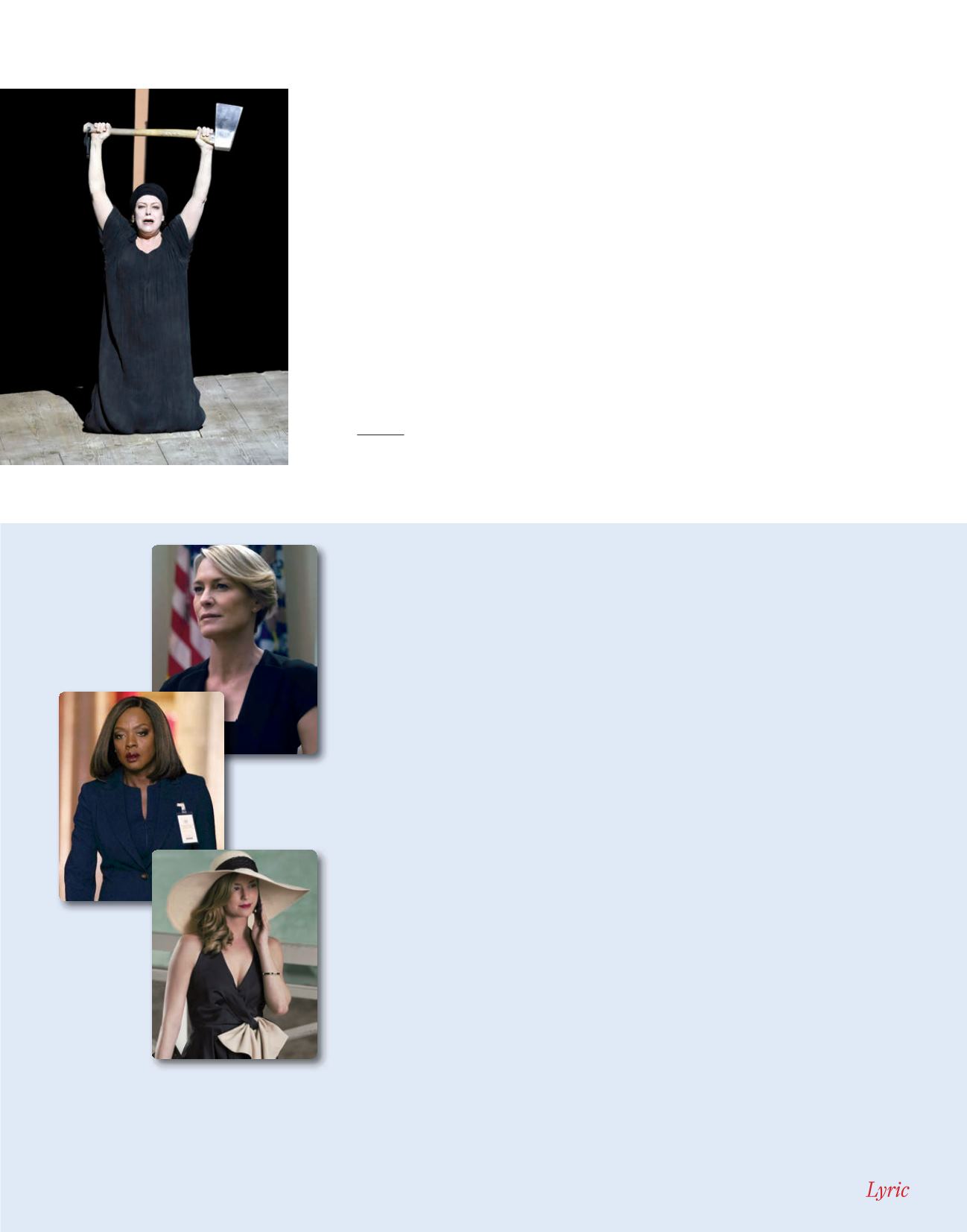
WILFRIED HÖSL/BAYERISCHE STAATSOPER
Nina Stemme in
Elektra
at the
Bavarian State Opera in Munich.
32
|
February 2 - 22, 2019
Modern Match –
Elektra
Spend enough time watching Netflix and, soon enough, it starts to recommend content using what
can only be described as mind-reading. Television shows featuring a strong female lead? Sign me up!
Political/revenge dramas? I’m hooked! But to binge-watch something – to invest time and emotions in a
story – it must have the greatest actors, thrilling plot twists, and an undercurrent of psychological sizzle
that keeps viewers watching. In short, it must follow the formula that Richard Strauss used more than a
century ago in
Elektra
.
What makes
Elektra
so compelling? e title character, to start. Elektra is opera’s antihero, one who
elicits horror and pity in equal measure; horror due to her all-consuming desire for revenge, and pity due
to…well, who wouldn’t be driven to extremes by history’s most dysfunctional family? e antihero is a
trope that modern audiences are familiar with. Elektra has the ruthlessness of Robin Wright’s Claire
Underwood in
House of Cards
, the lethal love of Emily VanKamp’s Emily orne in
Revenge
, and the
inner intensity of Viola Davis’s Annalise Keating in
How to Get Away with Murder
. Just as these shows
need top-tier actresses to pull off these characters, Strauss’s opera requires a singer at the height of her
musical and acting talent.
Just as in the opera, these kinds of shows are adept at mining the characters’ relationships to
heighten the drama. Family members often find themselves on opposite sides of a moral disagreement,
such as on
Scandal, Empire,
or
e Good Wife
. ey seem to suggest that love among parents, siblings,
and spouses is more conditional than we’d imagined. In the opera, Elektra’s mother Klytämnestra
presumably loves her children (that is, until they plot to kill her), and the love between siblings is strained
as they disagree over the best course of action. rough this, audiences discover what happens when
family is not the comfort it’s supposed to be, but a source of stress, anxiety, drama.
All of this leads to the final tier of the
Elektra
formula: intensely emotional writing. e best dramas
employ writers who weave a character’s inner thoughts naturally into dialogue. In television they rely on
longstanding themes to unify the show over many seasons. It’s not an easy task, but when done well, the
show becomes electric. is is why writers like Shonda Rhimes and Ryan Murphy are household names;
their dramas don’t shy away from honest, emotional confrontation or artistic risks. e same is true of
Hofmannsthal’s libretto and Strauss’s music. e composer delves into his characters’ psychology using
leitmotifs
and colorful dissonance. He associates Elektra’s character with harmonies that can’t quite
resolve, just as Elektra’s mind cannot resolve as she is consumed by revenge. It’s no wonder that while
some adore this opera, others find its music off-putting and exceptionally modern despite its age; just as
Elektra makes no effort to please her audience, neither does Strauss. He captures the gritty, sizzling drama
that makes the
Elektra
formula so enduring.
Meg Huskin
e writer, an intern in Lyric’s marketing and communications department in spring 2018, is currently the
relationship marketing associate at the Chicago Symphony Orchestra.
(Top to bottom) Robin Wright as Claire
Underwood in
House of Cards;
Viola Davis
as Annalise Keating in
How to Get Away
with Murder;
Emily VanCamp as Emily
orne in
Revenge.