


 31 / 74

February 17 - March 16, 2018
|
31
of the work’s humor, in Act One, derives
from the fact that the women take their own
emotions seriously, but we are urged to see that
they are only play-acting, imitating literary
expressions of passion. (Singer-actresses have
a challenge: while acting they must create
the impression of mere play-acting, and later
on show how different that is from genuine
feeling.) Throughout Act One, Mozart’s music
serves Da Ponte’s cynical purpose quite well,
creating an artificial comedy with characters
who are essentially cardboard cutouts and
objects of knowing laughter (by Don Alfonso
and the knowing Despina, and by us). We
know very little about the nature of Mozart
and Da Ponte’s collaboration, but we certainly
have no evidence that, like Verdi, Mozart
controlled the process and insisted on getting
his way; Da Ponte’s letters suggest just the
opposite, rightly or wrongly.
But Mozart cannot help taking emotions
seriously, and by Act Two his genius for
emotional insight, range, and particularity
takes over, breaking the clever mold and
subverting its purpose. In the other Da Ponte
operas, it is also true that Mozart supplies
emotional depth to texts that might have been
set otherwise. (Just imagine, for example, in
how many ways the text of Cherubino’s aria
“Voi che sapete” in
The Marriage of Figaro
might have been set, and how completely it
might have lacked the tender longing that it
in fact expresses.) In
Così
, however, the music
doesn’t just render emotionally determinate a
text that is indeterminate; it actually subverts
the entire point of the libretto. No, Don
Alfonso, emotions are not just a game, they
are real, and people have deep, interesting, and
highly individual emotional lives.
In Act One, the girls are not very
different from one another, and both play-act
at emotions with a grandiosity that signals an
absence of authentic self-knowledge and real
erotic experience. In Act Two, both discover
depths of emotional response in themselves –
in highly particular ways. Both Kerman and
philosopher Bernard Williams focus on the
duet between Fiordiligi and Ferrando, “Fra gli
amplessi” (“In the embraces”), which shows
Fiordiligi discovering love, and so discovering
new capacities in herself. Emotions strike both
of the lovers as mysterious, but also as totally
real and urgent, as real as anything in the world
can be. (And this is so, whether the emotions
actually last or not: so long as they exist, they
are both real and at the core of the person’s
humanity.) The contrast between Fiordiligi’s
Act One aria, where she is playing around
with ideas of constancy like a would-be drama
heroine, and this duet, with its soaring phrases
and tremulous expression of passion, could
not be more striking – and moving, too, as
if we are seeing a mature woman being born.
Kerman seems to prefer the emotions of the
serious pair to those of the comic pair simply
because they
are
serious. Williams’s preference
for the serious pair must be understood in
connection with his often-expressed preference
for Wagner’s
Tristan und Isolde
as
the
operatic
paradigm of genuine love. (In introducing the
posthumous collection in which his article on
Così
appears, Williams’s widow notes that he
tested their budding relationship by taking her
to a performance of
Tristan
, to see how much
she loved it!)
But this is Mozart, the same Mozart who
shows again and again that playfulness and
humor can be a supreme expression of love’s
reciprocity. (And isn’t this an important truth
in real life?) So I propose (
contra
Williams
and Kerman, who are a bit contemptuous of
the more light-hearted lovers) that we also do
justice to the other pair. The moment in all
opera that most unfailingly makes me weep for
sheer joy at the precariousness and lovability
of the world is Dorabella and Guglielmo’s
Act Two duet, “ll core vi dono” (“I give you
a heart”). The usual staging has him give her
a heart-shaped locket as a token of love. She
accepts it, and they then joke that the heart that
was in one breast is now beating in the other’s:
his heart (the locket) is now on her breast, and
(she says) hers has now gone over there and is
beating in his. The music first expresses tender
playful alternation, and then, with the delicate
staccatos of the line “E batte così” (“And beats
just so”), they are suddenly together.
(That’s where I cry, invariably.) “O
cambio felice,” “O happy exchange.”
Dorabella has already said that she
chooses Guglielmo because he seems
more playful – and one is painfully
aware that Ferrando, her original fiancé,
was therefore utterly wrong for her (and
right for Fiordiligi), since he is all lofty
sentiment and no play. And now, with
Guglielmo, she suddenly finds what
she wanted all along: in the intimacy of
joking and play she finds love’s reality,
as the hearts change places and then
somehow beat in harmony, though from
the opposite place.
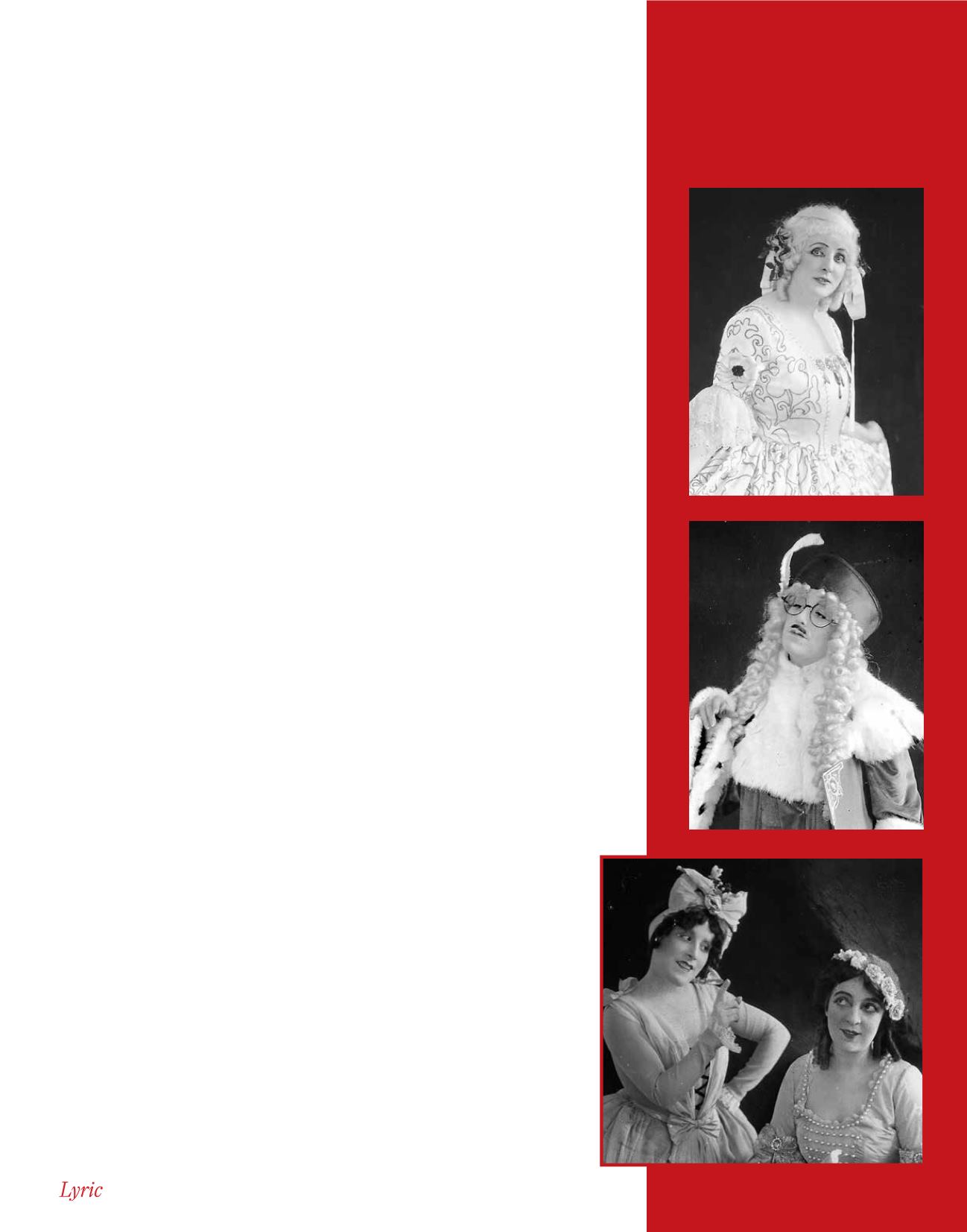
Not until 1922 did an American audience
hear
Così fan tutte
. In the premiere
at the Metropolitan Opera, English
soprano Florence Easton (top) played
Fiordiligi, Spanish soprano Lucrezia Bori
(center) was Despina, and American
soprano Frances Peralta (bottom,
with Bori) portrayed Dorabella.
HERMAN MISHKIN / METROPOLITAN OPERA ARCHIVES
HERMAN MISHKIN / METROPOLITAN OPERA ARCHIVES
HERMAN MISHKIN / METROPOLITAN OPERA ARCHIVES