


 33 / 74

O P E R A N O T E S | L Y R I C O P E R A O F C H I C A G O
February 17 - March 16, 2018
|
33
Modern Match -
Così fan tutte
and
She's the Man
Martha C. Nussbaum, Ernst Freund
Distinguished Service Professor of Law and Ethics
at The University of Chicago, has also taught at
Harvard, Brown, and Oxford universities.
Her
latest book,
Aging Thoughtfully: Conversations
About Retirement, Romance, Wrinkles and
Regret,
appeared in 2017 and is co-authored
with her colleague Saul Levmore.
Her newest
book,
The Monarchy of Fear: A Philosopher
Looks at Our Political Crisis
, will appear
in July 2018 from Simon and Schuster. In
2016 she received the Kyoto Prize in Arts and
Philosophy.
The theme of mistaken identity has been intriguing audiences for centuries, from
Shakespeare’s
Comedy of Errors
to Disney’s
The Parent Trap.
Mozart’s
Così fan tutte
is no
exception as the two officers, Ferrando and Guglielmo, disguise themselves from their
fiancées in a need to prove that Don Alfonso is wrong. The (unbelievable) disguises of
Così fan tutte
and the overall
use of mistaken identity isn’t unlike that of DreamWorks’s
hit romantic comedy of 2006,
She’s the Man,
loosely based on Shakespeare’s
Twelfth
Night
.
The opera and the film both begin with commentary on the nature of women: Don
Alfonso asserts to the two young men that women are fickle, including their fiancées. In
She’s the Man
, Viola is denied the chance to play for the men’s soccer team because the
coach believes women simply aren’t as athletic as men. According to Alfonso and the
soccer coach, women are weak.
This leads to an explicit need to prove these doubters wrong. Ferrando and
Guglielmo agree to Alfonso’s bet, claiming their fiancées are faithful. They disguise
themselves as “Albanians,” who will woo the sisters while their fiancés (that is, their true
identities) are away at war. Similarly, Viola decides to prove the coach wrong by going
to an all-boys boarding school and joining their soccer team. She does this by disguising
herself as her twin brother, Sebastian. The characters all use disguises to help prove their
point.
In recent decades the ending of
Così
has been staged different ways: although
most often the couples return to their original partners after Don Alfonso wins his
best, sometimes the young women go with their new partners, and some directors have
them all go their separate ways with no one united at the end. The DreamWorks film
has an unambiguously happy ending: Viola’s identity is revealed when Sebastian comes
back to school. She can then prove that, as a woman, she was good enough to play on a
men’s soccer team and confess her love to Duke, giving her a win-win situation. Perhaps
mistaken identities can be helpful after all!
— Margaret Rogers
The author, Lyric’s
dramaturgy intern
last summer, is in her
senior year at the
University of Minnesota.
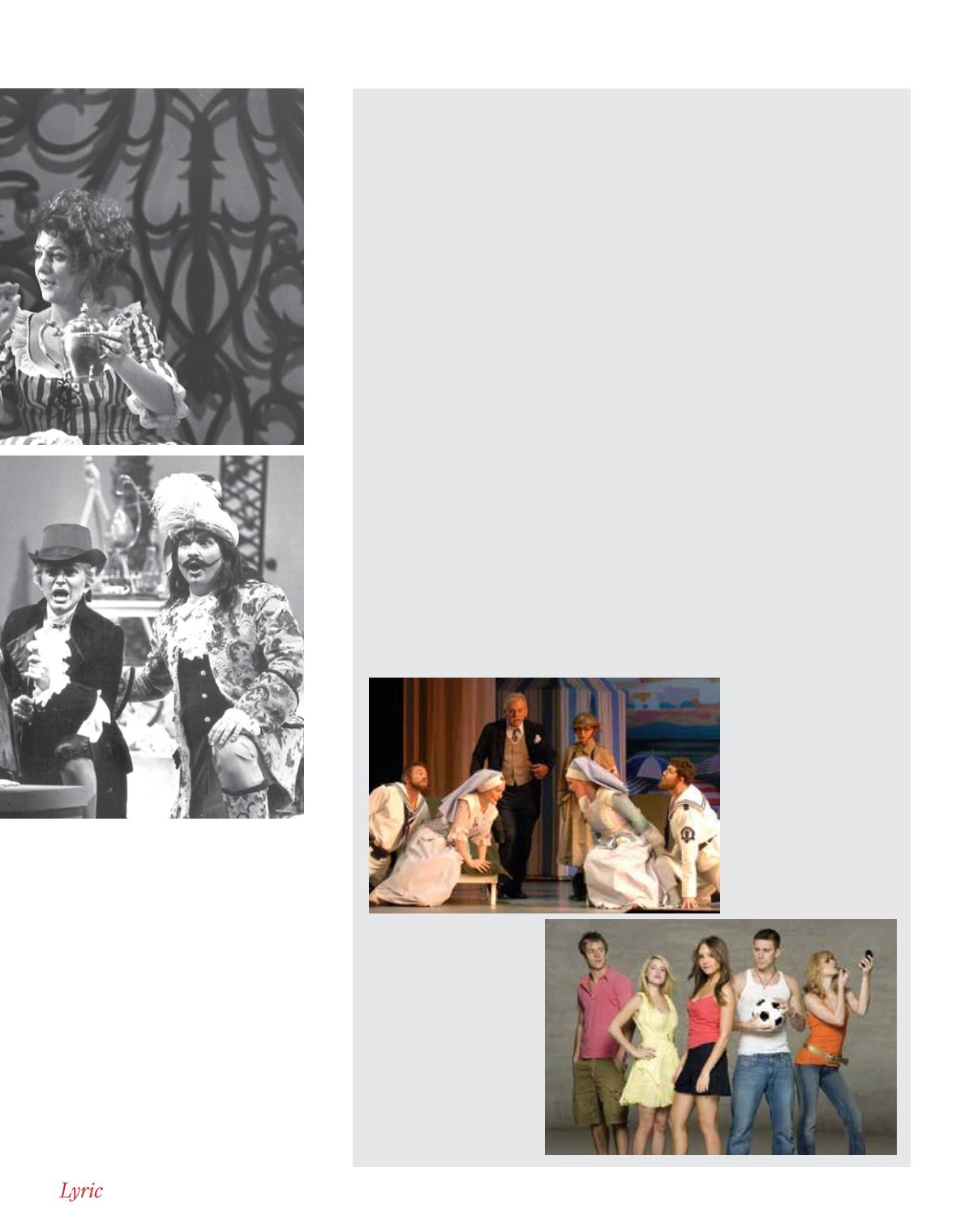
Così fan tutte
at Lyric, 1987/88:
(middle) Don Alfonso (Timothy Nolen)
offers a gold piece to Despina (Marie
McLaughlin); (bottom) the disguised
Ferrando (Jerry Hadley, far left)
and Guglielmo (Alan Titus,
far right) with Don
Alfonso and Despina,
the latter disguised
as a quack doctor.
The casts of
Così fan tutte
(Lyric, 2006/07)
and
She's the Man
(Paramount, 2006).