


 32 / 74

O P E R A N O T E S | L Y R I C O P E R A O F C H I C A G O
32
|
February 17 - March 16, 2018
that the reality of a real war lies behind the
comedy, and that this reality, leaving nothing
as it was before, renders the ending yet darker.
John Cox, original director of this production,
writes me that, as he sees it, the entire comedy
“is played out on the edge of this abyss,”
and that the darkness of the ending derives
from this background reality. This suggestion
(whether it’s about the libretto or the music,
or both) dovetails with the ideas I have been
exploring, though it also suggests a different
orientation for our attention. Such layers show
the work’s multivocal richness. And they surely
do not negate the music’s astonishing capacity
for the expression of love’s risks and delights.
In effect, as Kerman wittily puts it, the
second act belongs not to Don Alfonso but to
“Don Wolfgango,” who, being himself, took
emotion very seriously – including its soaring
heights but including, as well, its capacity for
tender play – and probed the characters’ depths
with varied and aching effect. By offering the
maid Despina no corresponding individuality
in passion, Mozart allows us to see that in this
world emotional individuality requires leisure
and may be incompatible with labor.
Act Two belongs to Mozart, but it must
end as Da Ponte wrote it. Although the work
has been staged in multiple ways, we are
evidently supposed to think that the girls go
back to their original partners. (Alfonso tells
the lovers to marry the girls
in spite of
their
fickleness, which implies that they take their
original partners back. This is also the “lesson”
intended from start to finish, in the libretto
that is.) According to the libretto, there is no
loss, because all is convention and emotions
are factitious anyway. But given the music
of Act Two, the ending is deeply disturbing,
and the message finally conveyed a very
unpleasant one: as Williams puts it, “the idea
that emotions are indeed deep, indeed based
on reality, but the world will go on as though
they were not, and the social order, which
looks to things other than those emotional
forces, will win out.” We might even see in the
work a critique of the institution of marriage,
as inimical to genuine love, at least for women.
Williams thinks that Mozart and Da
Ponte collaboratively create this dark and
disturbing insight. I find more persuasive
Kerman’s suggestion that the libretto is one
thing, the music in some respects quite another,
and Mozart is trapped by the contrivance of
the libretto, creating an ending that turns out
jarring and unsatisfying.
And what of the war to which the men
march off, to cheerful choral song in praise
of the military life? Is that part of the comic
contrivance, or is it all too real? Might war not
be another way in which the conventions of
the world treat human emotions as if they do
not matter? The present production suggests
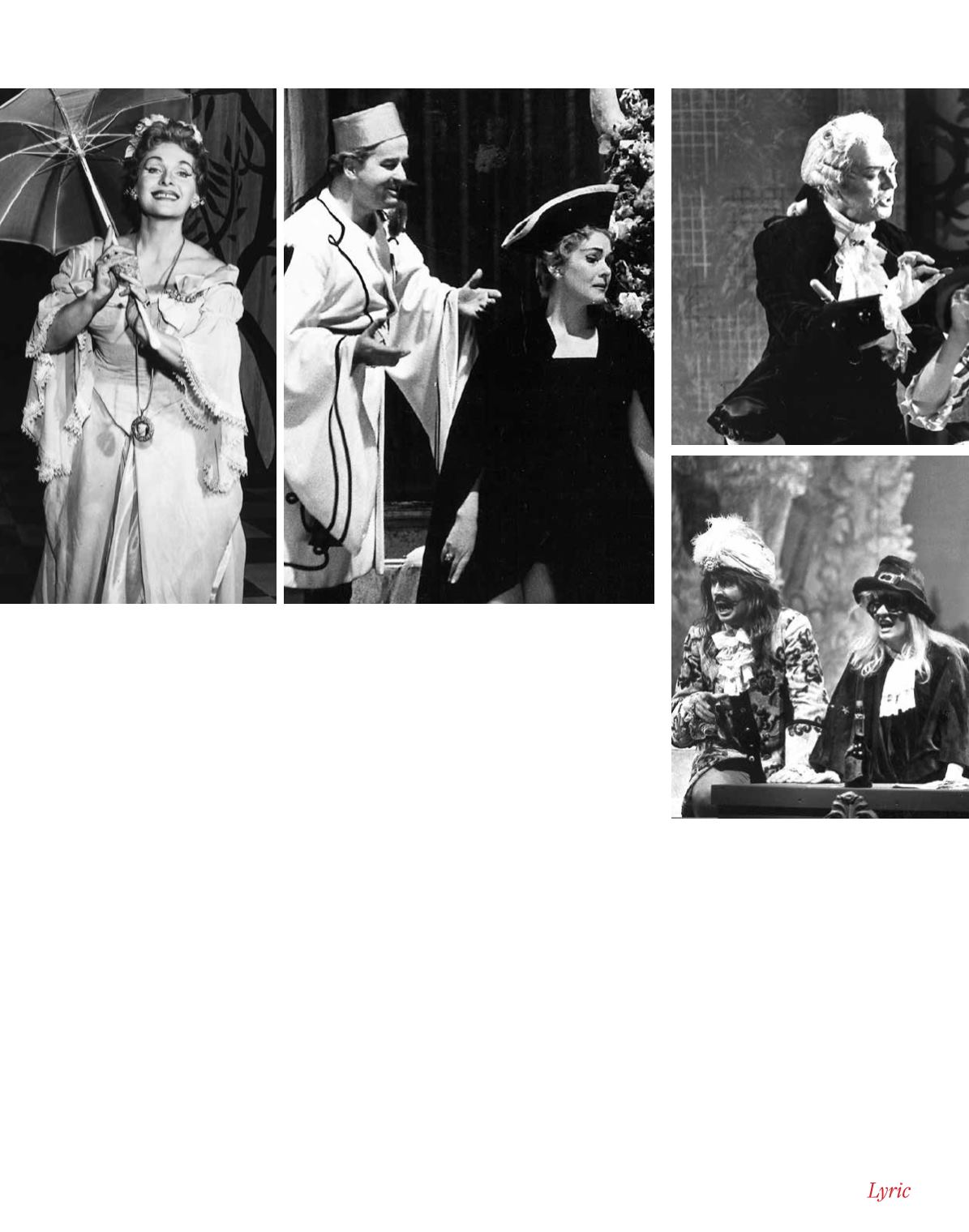
Fiordiligi (Elisabeth Schwarzkopf, left), happy and carefree in Act One. In Act Two, dressed in
her fiancé Guglielmo’s cloak and hat, she is about to rush off to find him in battle when she is
wooed by the disguised Ferrando (Léopold Simoneau):
Così fan tutte
at Lyric, 1959.
TONY ROMANO
TONY ROMANO
NANCY SORENSEN
NANCY SORENSEN