


 34 / 74

We are told next to nothing about the six
characters who populate
Così fan tutte
. (Even
the two sisters’ hometown being Ferrara is a
piece of opportunistic flattery by the librettist,
who at the time was the lover of the soprano
nicknamed “La Ferrarese.”) Apart from
Despina being a maid, the only useful fact is
that Ferrando and Guglielmo are soldiers.
Yet the audience hardly sees them as real
soldiers, men whose business is to go forth
and kill or be killed, because this identity is
quickly suppressed. As part of Don Alfonso’s
fictive stratagem they become “Albanians,”
performers in a masquerade that deceives their
lovers, the aforementioned sisters. By this
means, the realities of war are forced out of the
story and our two killer heroes are transformed
to mere actors.
For the sisters, however, the war is an
actuality and its possible outcomes must
be faced. Their fiancés, one or both, might
be killed, maimed, or never return. Some
interpretations of constancy would forbid
them to accept other offers of love should
the worst happen. Meanwhile, they owe it
to their loved ones to be steadfast as a source
of strength. This much they know about love
from their education.
Under pressure from the “Albanians”
and Despina, they discover that war can give
to love a sudden urgency. Faced with the
likely mortality of their fiancés, they find
after all that the erotic fulfillment of love as
proffered by the Albanians is a surer route to
their happiness. They are invited into, perhaps
entitled to, that last-chance embrace. Their
lovers may never return, but the Albanians are
here now.
As an alternative reading, suppose that
the war is not a part of the masquerade,
that events in the outside world that Alfonso
cannot control ironically convert his fiction
to fact, thus vindicating the sisters’ credulity
and inflicting a well-deserved sting on their
fraudulent men.
The conclusion of
Così
has always struck
me, and many others, as smug (Don Alfonso)
and craven (everybody else) – in short,
unsatisfactory. None of the four lovers is the
same person at the end as at the beginning.
The truth, revealed by fiction, is that they are
all changeable. Can the original pairings be
restored when there has been such a betrayal
of trust? It’s clear that both men love Fiordiligi
and that Dorabella is despised by the volatile,
male-chauvinist Guglielmo, whose friendship
with Ferrando must be seriously damaged by
mutually inflicted wounds. Any reconciliation
founded on such demonstrable fault-lines
would be short-lived. Alfonso’s experiment
may have won him his bet, but it only
answered one question. It leaves a host of
others unaddressed.
By bringing the war in from the outside,
by moving it from fiction to fact, by refusing
to judge the sisters’ choices as immoral and by
rejecting Don Alfonso’s glib reconciliation, we
can open up the spurious closure of the text
and keep the search for truth in motion.
The sisters have learned much about love
in a time of war. So, unexpectedly, have the
men, who must now become soldiers again.
Don Alfonso’s 24-hour masquerade has been a
dress rehearsal for the real thing.
— John Cox
Reprinted by permission of San Francisco Opera.
D I R E C T O R ’ S N O T E | L Y R I C O P E R A O F C H I C A G O
34
|
February 17 - March 16, 2018
Love in a Time of War
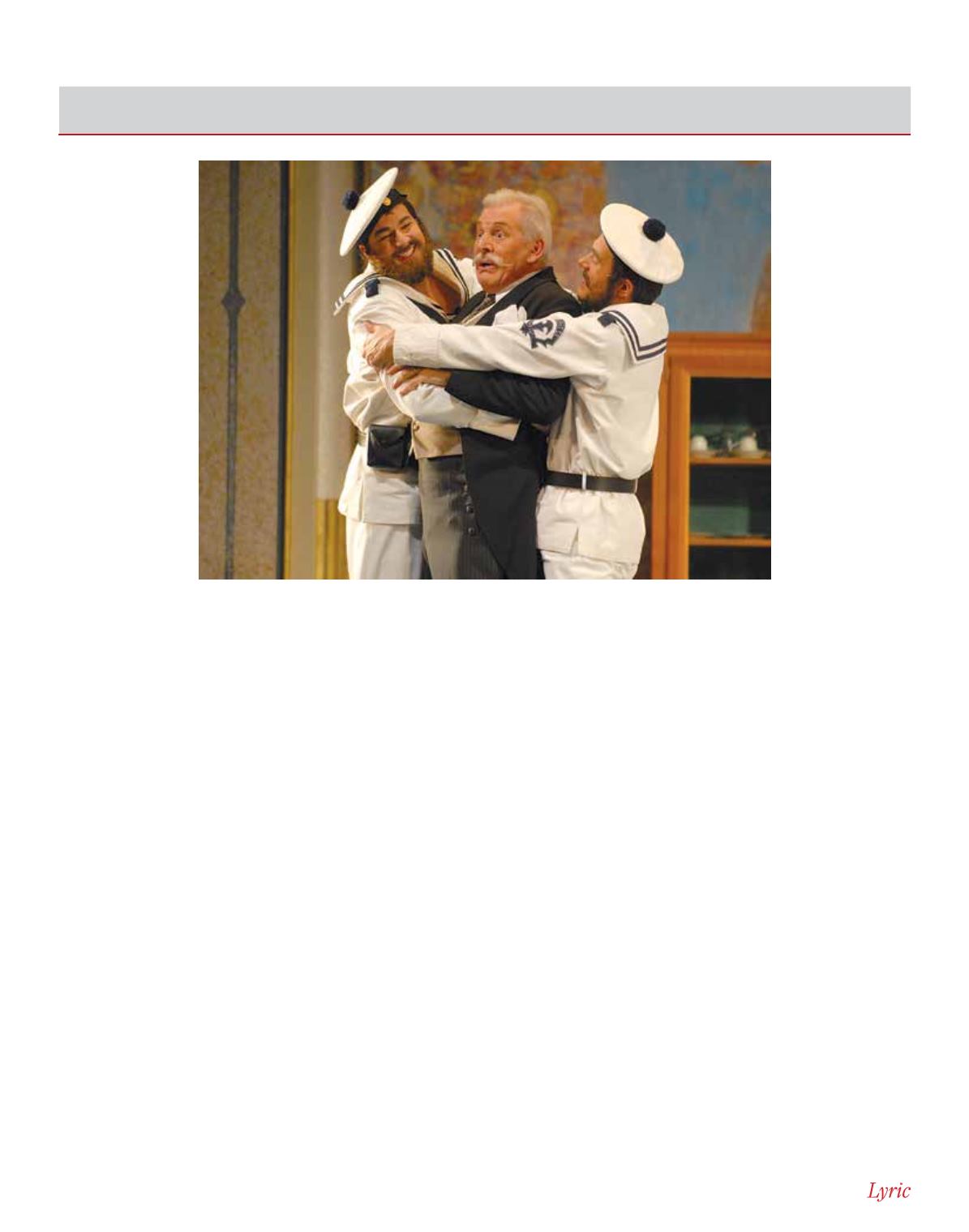
For a moment, Ferrando (Eric Cutler, left) and Guglielmo (Nathan Gunn, right), get the better of Don Alfonso
(Sir Thomas Allen, center): John Cox’s production of
Così fan tutte
at Lyric, 2006/07 season.
DAN REST